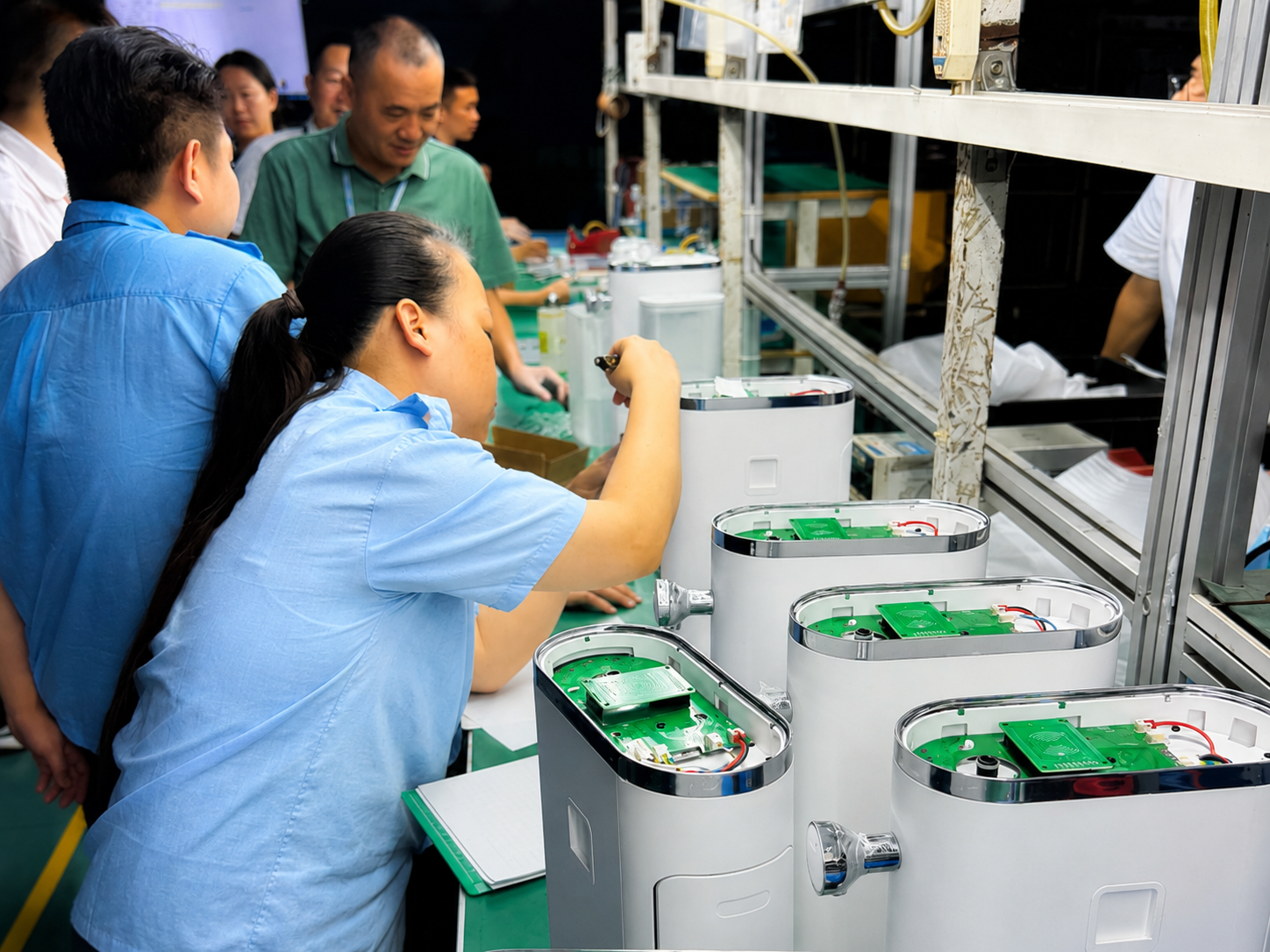
Most sustainability conversations begin with a material sample.
The product is already designed. The architecture is frozen. Tooling is moving. Then someone places a recycled or plant-filled plastic sample on the table.
It looks greener.
You can see the natural particles. The texture feels different from standard ABS. The material gives marketing an immediate story.
Then the engineering questions begin.
Will it survive a drop? Will the clips crack during assembly? Can the supplier maintain the same appearance between batches? Will it warp inside the existing mould? Can it withstand heat, sunlight, cleaning products and years of use?
The material was the exciting part of the conversation.
The product requirements were the important part.
After years of taking hardware products from engineering into mass production, we have learned that the greener option is rarely the one that looks the greenest in the sample room.
A better material can improve a good product.
It cannot rescue a weak one.
This article focuses primarily on consumer electronics and connected hardware. The environmental priorities will vary between a wearable, smart-home device, battery-powered product and mains-powered appliance.
But the same principle applies:
Find where the meaningful impact sits before reaching for the most visible green tactic.
A physical product creates environmental impact across its complete life.
Materials need to be extracted and processed. Components are manufactured. The product is assembled, tested, packaged and shipped. It then consumes energy, batteries, filters or other resources while being used. Eventually, it is repaired, replaced, recycled or discarded.
Changing one enclosure material only affects part of that system.
For one electronic product, energy consumption during use may dominate. For another, the battery may determine its useful life. For a small connected device, the biggest avoidable impact may be replacing the entire unit because one connector failed or its software is no longer supported.
There is no universal sustainability priority for every product.
The strategy starts by identifying which decisions matter most for yours.
Life-Cycle Assessment, or LCA, is a structured way to evaluate environmental impact across raw materials, manufacturing, distribution, use and end of life.
A full LCA can require specialist data and analysis. Not every product team needs to begin with a complete formal study.
But every team can use life-cycle thinking.
If a lighter material makes the housing less durable, have we improved the product or moved the impact into earlier replacements?
If a removable battery adds size, connectors and assembly complexity, does the longer product life justify those additions?
If a recycled resin creates more rejects, longer cycle times or lower product reliability, is the complete system still better?
If a smaller package causes more transit damage, did we reduce waste or create more of it?
The purpose is not to make every decision perfect.
It is to stop improving one visible metric while making the overall product worse.
When a product fails, the customer sees one broken device.
An operator sees everything behind it.
The original unit was moulded, assembled, tested, packaged and shipped. Then customer support opens a ticket. A replacement leaves the warehouse. Another carton is used. Another delivery is booked. The failed product may travel back to a service centre, returns warehouse or recycling facility.
One small failure can activate almost a second supply chain around the same sale.
That is why reliability belongs inside the sustainability strategy.
Sometimes the most meaningful improvement is strengthening a screw boss that repeatedly cracks, moving a connector away from a high-stress area or improving heat management around a battery.
It might mean selecting a motor with a longer service life or making a pump, cable, fan or seal accessible before it predictably wears out.
None of these decisions produces a dramatic environmental badge.
They can prevent thousands of premature replacements.
Quality and sustainability are not the same thing.
A reliable product can still consume too much energy, use high-impact materials or be impossible to recycle. But an unreliable product creates an environmental problem before any of those later questions can be answered.
The product must first perform consistently for its intended life.
That requires clear requirements, appropriate component selection, reliability testing and controlled manufacturing processes.
The objective is not to over-engineer everything. A product does not need aerospace specifications when it will live quietly on a bedside table.
It needs to survive its real environment with enough margin to handle normal use, manufacturing variation and ageing.
That is good engineering.
It is also one of the foundations of a greener product.
For connected electronics, useful life is not only mechanical.
A perfectly functional device can become obsolete because the app stops working, cloud services are discontinued, security updates end or a new phone operating system is no longer supported.
The enclosure may still look new. The battery may still hold a charge. The electronics may still function.
The product is dead because the software around it disappeared.
This makes software and service planning part of ecodesign.
How long will the product be supported? Can essential functions continue without the cloud? Can firmware be updated securely? What happens if the company changes platform or service provider?
It makes little sense to engineer a housing for ten years of use if the software business model assumes three.
Making a product last longer is valuable, but useful life is only one part of the system.
An inefficient product can consume unnecessary energy for years.
Depending on the category, environmental performance may be influenced by:
For a low-power sensor, manufacturing and battery replacement may matter more than daily energy consumption. For an appliance with a motor or heating element, the use phase may dominate.
The product team needs to understand the difference.
Energy efficiency is often discussed late, as though it were a component specification.
In practice, it starts with product architecture.
Does the device need to remain connected continuously? Can it enter a low-power state? Is the selected processor oversized for the job? Can firmware reduce unnecessary polling or screen time? Is the battery large because the use case requires it—or because power consumption was never optimized?
These decisions affect battery size, charging frequency, thermal performance, product life and user experience.
They also affect cost.
A lower-power architecture can sometimes support a smaller battery, smaller enclosure and simpler thermal design. Environmental and commercial performance improve together.
That is the ideal outcome: not sustainability as an added cost, but better engineering removing cost and impact from the same system.
Factories do not create all manufacturing waste.
Sometimes they inherit it.
A design arrives with seven cosmetic parts where three could have done the job. The enclosure must be moulded, sanded, painted, UV coated and laser marked before assembly. The battery sits behind a housing that cannot be opened without breaking clips.
Three different screws are used for no clear reason. A fragile connector sits directly in the cable’s load path. A manual adjustment is required on every unit because the architecture never accounted for normal production variation.
By the time production starts, much of the future complexity is already locked into the product.
The factory can optimize machine settings, build fixtures and add inspections. It cannot easily remove decisions that have already been tooled, certified and approved.
This is why ecodesign has to enter while the architecture, materials and manufacturing processes can still change.
Not after tooling.
Not after certification.
And definitely not when marketing starts looking for a greener story two weeks before launch.
We once reviewed a moulded enclosure with a cosmetic defect appearing repeatedly around the same area.
The factory proposed adding another inspector before assembly.
That protected outgoing quality.
It did not remove the waste.
The factory was still using resin, electricity, machine time and labour to produce parts it expected might be rejected.
So we went upstream.
Was the resin being dried correctly? Was one mould cavity behaving differently? Was cooling balanced across the tool? Had the cycle been shortened to increase output? Was the defect linked to one material batch?
Or were acceptable parts being rejected because nobody had defined what acceptable variation looked like?
The greener solution had nothing to do with selecting a new plastic.
It was correcting the process so the factory stopped creating scrap every cycle.
This is what First-Pass Yield measures: the percentage of units that complete a process correctly without rework.
Imagine 1,000 units entering production. Eight hundred and fifty pass immediately. Another 100 are recovered through rework, while 50 are scrapped.
The factory eventually ships 950 units.
But its First-Pass Yield is only 85%.
It did not cleanly produce 950 good products. It fought its way to 950, consuming extra labour, energy, handling and production capacity along the way.
A good final shipment quantity can hide a wasteful process.
A rejected moulded part contains resin and moulding energy.
A populated PCBA that fails testing already contains components, solder, machine time and inspection labour.
A finished product rejected at final inspection may contain electronics, a battery, enclosure parts, assembly labour, firmware, testing and packaging.
The later the defect is discovered, the more resources it carries with it.
This is why final QC cannot be the complete sustainability plan. By then, the waste has already been created.
The objective is to build quality into the requirements, architecture, supply chain and production process so fewer defects reach the end.
On one enclosure we reviewed, the individual measurements initially appeared acceptable.
Then the complete product was assembled and placed on a flat surface.
It rocked.
One section was cooling differently and pulling the overall geometry out of shape. Many dimensions looked reasonable on the inspection report, but the assembly told the truth.
The mould could have continued producing those housings. Operators could have adjusted them manually. Some units would have been reworked. Others would have been rejected.
A small process imbalance would have repeated itself across every future batch.
Fixing it was not presented as a sustainability initiative.
But preventing recurring warpage saved material, assembly time and future failures.
Sustainability at scale often looks exactly like this:
One small process improvement repeated thousands of times.
Repairability is easy to oversimplify.
Screws are good. Glue is bad. Modules are sustainable. Sealed products are not.
Real hardware is less cooperative.
Every removable module can add another connector, cable, fastener, tolerance interface and potential failure point. We have seen architectures that looked beautifully modular in a presentation become considerably more fragile during industrialization.
There were more cables to route, more connectors to seat and more places for assembly to go wrong.
The better question is not:
Can every component be removed?
It is:
Which component is most likely to end the useful life of the product?
For electronics, that might be the battery, display, charging connector, cable, fan, pump, motor or seal.
Design the repair strategy around those risks.
Sometimes the user can perform the repair. Sometimes it belongs in a service centre. Sometimes replacing one tested subassembly is safer and more reliable than repairing individual components.
The objective is not maximum disassembly.
It is preventing one predictable failure from killing the entire product.
A removable battery might increase product life but make the product larger. Additional seams and fasteners may affect water resistance. User access can create electrical or safety risks.
Adhesive can complicate repair, but it can also provide sealing, structural support and a smaller product. Screws make disassembly easier but add components, bosses, assembly time and potential cosmetic constraints.
There is no universal answer.
The right solution depends on the product’s failure modes, safety requirements, service model and intended market.
Repairability and spare-parts availability are also becoming regulatory requirements for some categories and markets. These requirements need to enter product planning early enough to influence the architecture.
A repair strategy added after tooling will usually be an expensive compromise.
We are not against recycled, bio-based or natural-filled materials.
We work with them.
But we do not select them because they look green. We select them when they improve a defined environmental outcome and still satisfy the product requirements.
A material for consumer electronics may need to survive heat, UV exposure, cleaning chemicals, repeated impact, screw loading, thin snap-fits and tight dimensional tolerances.
It also needs to mould consistently, meet regulatory requirements and remain available across the production life of the product.
A resin can look excellent as a flat sample and behave differently inside a complete enclosure.
The clip cracks. The wall warps. The colour changes between batches. The cycle time increases. The natural texture creates more cosmetic rejects than the material it replaced.
None of this means the material is bad.
It means the material needs engineering.
Adding recycled content can reduce the amount of virgin material used.
A bio-based polymer may reduce dependence on fossil feedstocks. A natural filler may produce a distinctive finish without painting.
Those can be meaningful improvements.
But the complete effect depends on formulation, sourcing, processing, durability, production yield and end-of-life options.
A mixed material may become more difficult to recycle. A natural filler may change moisture sensitivity or mechanical performance. A recycled resin may require tighter incoming-material controls to maintain consistency.
The correct question is not:
How much recycled or plant-based content can we add?
It is:
How much can the product support while still meeting its performance, quality, production and useful-life requirements?
A supplier datasheet is useful, but it cannot validate the finished product.
A standard material specimen does not contain your snap-fit, thin wall, screw boss or cosmetic surface. It does not experience your assembly forces or run through your mould.
The supplier knows the resin.
The engineering team still has to prove the product.
“The supplier told us it is recycled” is not traceability.
It is a conversation.
Where did the material come from? Is it pre-consumer or post-consumer? What percentage is present? Does every batch use the same formulation? Can the resin batch be connected to finished production?
Can the company still support the claim a year later?
Traceability becomes even more important when something goes wrong. A material becomes brittle, the colour changes or a compliance issue appears.
Without traceability, the team may have to treat every unit as potentially affected. With good records, the problem may be isolated to one supplier, material batch or production period.
Use a credible certification or chain-of-custody system appropriate to the material, product and market. Keep supplier declarations, certificates, incoming batches and finished production records connected.
Certification can support the material claim.
Engineering still has to prove the part.
Follow a cosmetic enclosure through a typical supply chain.
It is injection moulded, sanded, painted, UV coated, laser marked, bonded to a decorative component and returned for final assembly.
Every step creates another fixture, inspection, supplier handover and opportunity for rejection.
A client may ask for a greener paint.
Sometimes that is the correct discussion.
Sometimes the better question is:
Can we design the product so it does not need paint?
A mould texture may create the required appearance directly. A self-coloured resin may eliminate a secondary operation. One integrated component may replace several decorative parts.
This is where Design for Manufacturing and Assembly becomes a sustainability tool.
A simpler design can reduce tooling, materials, assembly time, supplier handovers, quality risks and scrap simultaneously.
Nobody will print “one fewer supplier handover” on the packaging.
The environmental benefit still exists.
Part reduction should not become another blind target.
Combining two components can simplify assembly, but it may make repair more difficult. Removing a protective finish may expose the material to UV or chemicals. Integrating functions can create a larger and more expensive replacement module.
The goal is not the fewest possible parts or processes.
It is the least complexity required to deliver the intended product life, experience and performance.
That is a much harder design problem.
It is also where experienced product development and NPI teams create real value.
We have seen teams reduce packaging too aggressively.
The new moulded-pulp insert looks cleaner. The box becomes smaller. Plastic disappears from the unboxing experience.
Then the transit test cracks the display.
Or the housing rubs against the insert. Or the carton collapses when stacked.
The team saved packaging material and created damaged finished products.
That is a poor trade.
Packaging reduction should be progressive and validated. Test the current design, remove material, test again, adjust the support geometry and repeat.
The greenest package is not the smallest one.
It is the smallest package that can deliver an intact product through the real distribution chain.
Packaging affects more than material consumption.
It affects master-carton density, palletisation, warehouse space, volumetric weight and container utilisation.
One unnecessary centimetre appears irrelevant on a single box. Across 50,000 units, it becomes warehouse volume, container capacity and freight cost.
This is another area where environmental and commercial performance can support each other.
Smaller, properly engineered packaging can use less material, reduce transportation volume and lower cost.
But the product still has to arrive intact.
The sequence matters.
Starting with the most visible environmental tactic can consume time and budget without addressing the product’s most significant impact.
A more useful process is:
Understand where the meaningful impact is likely to sit across materials, production, distribution, use, repair and end of life.
Use available data first. Move towards a more formal Life-Cycle Assessment when the product, claim or decision justifies it.
Remove unnecessary features, parts, finishes, packaging, energy consumption and production steps.
The cleanest process is often the one the product no longer needs.
Improve reliability, useful life, battery life, software support and access to the components most likely to fail.
Do not make the entire product modular if one targeted repair strategy will do.
Improve First-Pass Yield. Reduce scrap, rework, production variation and recurring field failures.
A stable process protects material, labour, energy, quality and margin simultaneously.
Evaluate recycled, bio-based or lower-impact materials after the functional and production requirements are clear.
Validate the material inside the actual product and process, not only through a supplier sample or datasheet.
Connect environmental claims to data, traceability and a clearly defined comparison.
What changed? By how much? Compared with which baseline? Across which part of the product or life cycle?
If the claim cannot answer those questions, it probably is not ready for the packaging.
Standards can help structure the work when they are used for the right purpose.
ISO 14006 provides guidance for bringing ecodesign into product development and environmental management.
ISO 14040 and ISO 14044 provide the principles and requirements behind Life-Cycle Assessment.
ISO 14021 covers self-declared environmental claims and how they should be evaluated and supported.
The standards do not choose the right architecture, material or repair strategy for you.
They improve how the decisions are structured, measured and communicated.
The practical questions remain straightforward:
A sustainability strategy that cannot survive engineering, NPI and mass production will struggle to create meaningful impact at scale.
Return to the material sample on the table.
The natural texture still looks good.
It may still be the right material.
But now we know what it needs to prove.
It must survive the real product environment. It must mould consistently. It must meet the mechanical and cosmetic requirements. Its supply and formulation need to be controlled.
Most importantly, it must improve the complete product without quietly shortening its life or creating more waste somewhere else.
That is the difference between selecting a greener-looking material and engineering a greener product.
Recycled materials matter.
Repairability matters.
Energy efficiency matters.
Packaging matters.
But they need to be considered as parts of one product system.
Make something people need. Make it reliable. Make production repeatable. Remove unnecessary complexity. Understand the use phase.
Then improve the materials, repair strategy, packaging and supply chain around it—and prove what actually became better.
Greener starts with better.
Need a partner who knows how to engineer, industrialize and scale better electronics?
Reach out to hello@sprnv.com.


.svg)

.svg)

.svg)